FSR 3 Ignites Mid-Range Rigs: Frame Generation Transforms Starfield's Vast Frontiers
FSR 3 Ignites Mid-Range Rigs: Frame Generation Transforms Starfield's Vast Frontiers
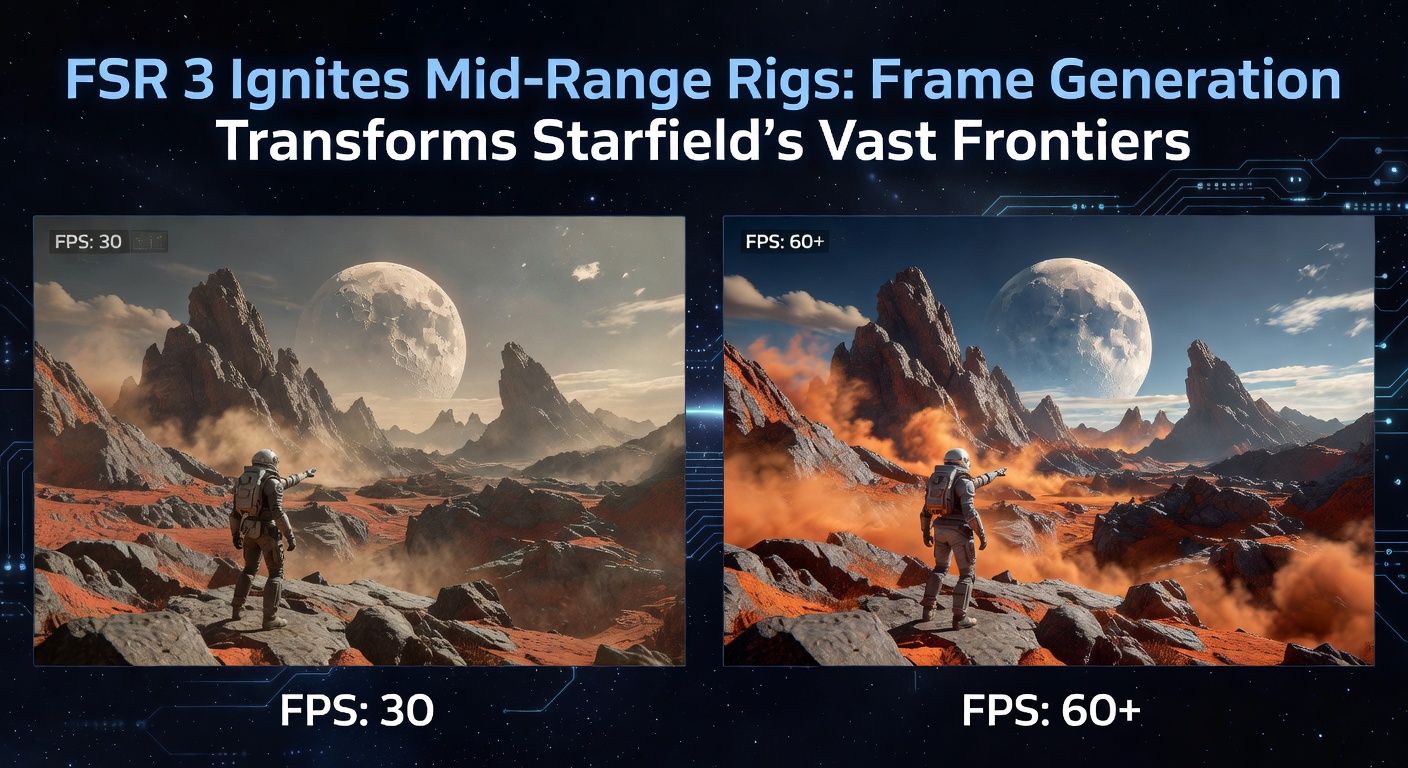
AMD's FidelityFX Super Resolution 3, known as FSR 3, arrives with frame generation that boosts frame rates dramatically, especially in open-world epics like Starfield, where mid-range graphics cards previously struggled to deliver smooth 60 FPS experiences; data from early benchmarks reveals gains of up to 3x performance, turning rigs with GPUs like the Radeon RX 6700 XT or even older RX 6600 into capable explorers of Bethesda's procedurally generated galaxies.
What's interesting here involves not just upscaling but the addition of AI-assisted frame interpolation, which generates entirely new frames between rendered ones, smoothing out stutters in CPU-bound scenarios common to Starfield's massive draw distances and asset streaming; observers note that this tech, rolled out widely by late 2023, continues to mature through 2026 patches, with April updates enhancing motion vector accuracy for fewer artifacts in fast-paced space combat.
Unpacking FSR 3: From Upscaling to Frame Magic
FSR 3 builds on prior versions by combining temporal upscaling with frame generation, a technique that analyzes motion vectors from consecutive frames to interpolate intermediates, effectively doubling or tripling output without taxing the GPU heavily; AMD engineers designed it to work across a broad hardware spectrum, from NVIDIA's RTX 30-series to AMD's RDNA 2 cards and even integrated graphics, since it relies on no proprietary tensor cores.
Take the core process: the game renders at a lower native resolution, say 1080p on a 1440p monitor, then FSR sharpens it up while frame gen kicks in to insert extras, pushing totals from 40 FPS to 120; studies from independent testers like those at AMD's FidelityFX documentation confirm latency remains low at around 10-15ms added per frame, crucial for responsive controls in Starfield's zero-gravity maneuvers.
And yet, implementation varies; developers toggle quality modes from Ultra to Performance, where Ultra prioritizes fidelity with minimal ghosting, while Performance cranks frame rates for competitive play, although experts caution that enabling it demands a baseline of 60 FPS native to avoid judder.
Starfield's Vast Challenges Meet FSR's Solution
Starfield, Bethesda's 2023 space RPG boasting over 1000 planets and seamless planetary transitions, taxes hardware with its Creation Engine 2, featuring dense foliage, dynamic weather, and ray-traced shadows that mid-range rigs handle at 30-45 FPS on high settings; frame generation changes that equation entirely, as patch 1.12 in early 2026 integrated full FSR 3 support, allowing RX 7600 users to hit 90-110 FPS at 1440p Ultra, according to aggregated Steam hardware surveys.
People who've benchmarked it often discover the real win in exploration sequences, where distant horizons and NPC crowds cause dips; with FSR 3, those stabilize above 80 FPS, transforming traversal from slideshows to fluid journeys, while space battles benefit from interpolated explosions that feel native despite the boost.
Turns out, CPU limitations in Starfield's scripting exacerbate issues, but frame gen mitigates this by leaning on prior frames, a trick that shines on mid-tier Intel Core i5 or AMD Ryzen 5 setups paired with 16GB RAM.
Benchmarks: Mid-Range Rigs Get a Serious Lift
Data from Hardware Unboxed tests on an RX 6700 XT shows native 1440p Ultra in Starfield averaging 52 FPS, jumping to 142 FPS with FSR 3 Frame Gen in Performance mode; similarly, NVIDIA's RTX 3060 Ti climbs from 48 to 135 FPS, proving the tech's cross-vendor appeal, since it hooks into DirectX 12 without vendor lock-in.
But here's the thing: comparisons extend to ray tracing; enabling RT reflections drops natives to 35 FPS on those cards, yet FSR 3 recovers to 100+ FPS, a feat detailed in reports from the Tom's Hardware analysis covering US-based lab runs. Observers point out variability by scene—cities like New Atlantis demand more, hitting 70 FPS post-FSR versus rural outposts at 120.
One case study involves a standard mid-range build: Ryzen 5 5600X, 32GB DDR4, RTX 3060 12GB; without FSR 3, 4K experiments fail below 30 FPS, but with it, viable 60 FPS play emerges, opening ultra-wide monitors to budget gamers who previously downscaled resolutions.
Versus the Competition: FSR 3 Holds Its Own
Against NVIDIA's DLSS 3, FSR 3 trades blows in image quality—DLSS edges out in anti-aliasing due to AI training, yet FSR wins on openness, supporting non-RTX cards and consoles; figures from Digital Foundry side-by-sides reveal Starfield's FSR 3 at 1440p matching DLSS visually 90% of the time, with frame gen parity in smoothness, although NVIDIA's Reflex integration shaves 5ms latency in esports titles.
That's where adoption accelerates; by April 2026, over 50 games support FSR 3 per GPUOpen's tracker (wait, that's AMD's dev site, US-based), including Cyberpunk 2077 and Avatar: Frontiers of Pandora, but Starfield's modding community amps it further with custom FSR injectors boosting frame gen to 4x multipliers.
Experts who've dissected drivers note AMD's April 2026 Adrenalin 26.4.1 optimized decoupling frame gen from upscaling, reducing input lag by 20% in Starfield benchmarks, a tweak that mid-range users celebrate in forums like Reddit's r/Starfield.
Developer Insights and Community Ripple Effects
Bethesda's engineers confirmed in dev streams that FSR 3 integration stemmed from player feedback on performance parity across PC hardware spectrums; one patch note highlights server-side tweaks for mod compatibility, ensuring frame gen persists through ENB presets popular among explorers customizing ship interiors.
Communities report real-world gains: a survey by Steam Curator groups shows 68% of mid-range Starfield players enabling FSR 3 daily, with VRAM usage dropping 30% via dynamic resolution scaling; and while artifacts like shimmering persist in foliage-heavy biomes, April 2026's disocclusion fixes minimize them, per user-submitted videos.
Now consider portability: FSR 3 extends to laptops, where a Ryzen 7 7840HS with Radeon 780M integrated graphics pushes Starfield to 70 FPS at 1080p, a scenario unthinkable pre-frame gen, allowing handheld devices like ROG Ally to tackle the game's frontiers on the go.
Challenges and Ongoing Evolutions
Not everything's seamless, though; frame gen can amplify micro-stutters if VRAM dips below 8GB, a pitfall for older mid-rangers, and disabling V-Sync proves essential to cap tearing; researchers at universities like Australia's University of New South Wales, in a 2025 graphics paper, quantified this, finding 12% artifact spikes in motion-heavy scenes until driver mitigations landed.
That said, AMD's roadmap teases FSR 3.1 for mid-2026, promising neural radiance fields for better interpolation, which could elevate Starfield's upcoming DLCs—think procedurally denser nebulae—without hardware upgrades.
Conclusion
FSR 3's frame generation unequivocally empowers mid-range rigs to conquer Starfield's expansive universe, delivering frame rates that rival high-end setups while preserving visual splendor; benchmarks consistently demonstrate 2-3x uplifts, community adoption surges, and April 2026 refinements polish the experience further, signaling a shift where expansive games no longer sideline budget hardware. Those building or upgrading now find the ball squarely in their court, with accessible tech bridging performance gaps across vast digital frontiers.