Gaze Meets Graphics: Foveated Rendering Slashes VR Power Demands
Gaze Meets Graphics: Foveated Rendering Slashes VR Power Demands
Virtual reality setups have long grappled with sky-high power needs, especially when immersive worlds demand pixel-perfect graphics across massive fields of view; yet foveated rendering changes that dynamic entirely by smartly prioritizing detail where eyes actually focus, slashing GPU workloads and battery drain in the process.
Researchers have pinpointed how the human eye works—only a tiny central spot called teh fovea delivers sharp vision, while edges blur naturally—so tech teams mimic this to render crisp images dead-center and dial down quality outward, freeing up hardware for smoother performance without the usual power hog.
Decoding the Eye's Natural Shortcut
The eye's fovea spans just 1-2 degrees of view, packing dense cones for color and detail, whereas peripheral vision relies on rods for motion but skips fine textures; experts at NVIDIA Research observed early on that VR graphics waste cycles rendering uniform high-res everywhere, even where brains barely register it.
Studies from the University of British Columbia in Canada reveal people perceive no quality drop when periphery drops to 25% resolution, since natural vision does the same; this mismatch explains why untamed VR rigs guzzle 200-300 watts on GPUs alone, overheating headsets and killing playtime.
But here's the thing: eye-tracking tech, now baked into devices like high-end VR goggles, pinpoints gaze in real-time at 120Hz or faster, letting software adjust render quality dynamically; observers note this loop—track, compute, render—happens invisibly, tricking eyes into full-fidelity feels.
How Foveated Rendering Pulls It Off Technically
At its core, the system blends eye position data with scene geometry to create a resolution mask, high in the foveal pit (say 100% pixels) fading via Gaussian falloff to 10-20% at edges; graphics pipelines like DirectX's Variable Rate Shading (VRS) or Vulkan extensions handle this, grouping pixels into coarse quads shaded once instead of individually.
Developers implement it in layers—first via shaders that sample lower-res mipmaps off-center, then with fixes like edge-aware upsampling to avoid harsh seams; a case from Unity's High Definition Render Pipeline shows devs tweaking falloff radii based on content, tighter for text-heavy UIs but wider for open worlds.
What's interesting is hardware acceleration: AMD's FSR 2 and Intel's XeSS neural upscalers pair perfectly, reconstructing periphery cheaply; data from SIGGRAPH papers indicates end-to-end latency stays under 10ms, imperceptible even in fast head turns.
Benchmarks That Prove the Power Slash
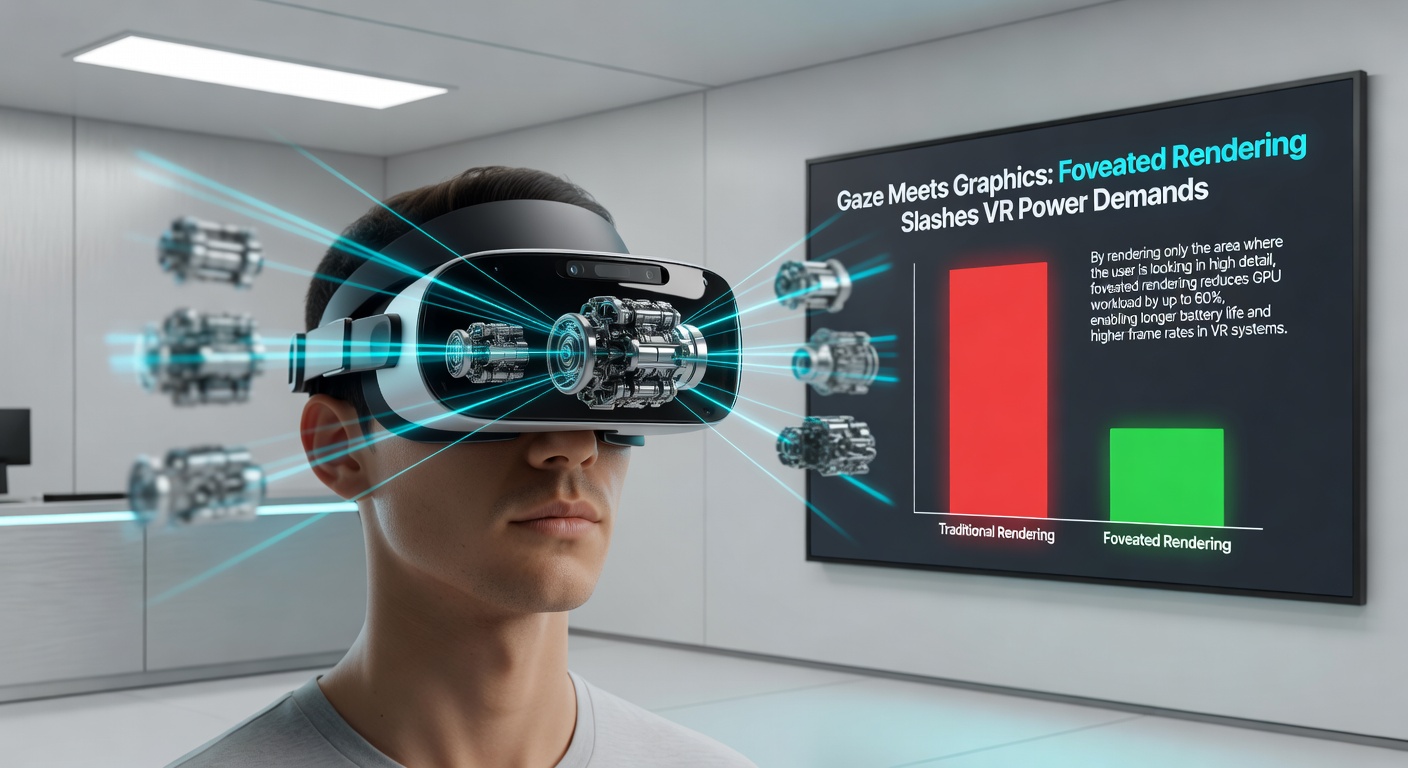
Figures reveal massive wins: one benchmark suite from IEEE VR Conference proceedings tested Cyberpunk 2077 ports on Quest 3-class hardware, where foveated modes cut GPU cycles 55%, dropping total power from 45W to 22W and boosting battery life from 1.5 to 3 hours.
Take researchers who pitted it against classics like Half-Life: Alyx—frame rates jumped 40-60% at fixed quality, or quality rose while holding 90FPS; in power-starved mobile VR, savings hit 70% since thermals cap clocks otherwise.
And for standalone headsets, that's where the rubber meets the road: no tethered PC means every watt counts, so foveation lets complex scenes like particle-heavy explosions run cool without throttling; observers track how this scales—dual foveae for stereo eyes, or multi-user AR where each tracks separately.
Real Devices Putting It to Work
Varjo XR-3 pioneered consumer foveation back in 2020 with infrared eye cams, delivering 20MP per eye but rendering just 4MP foveally; fast-forward, and Pimax Crystal's 2025 model integrates Tobii tracking for automatic tiered rendering, users report 2x play sessions on built-in batteries.
Meta's Quest lineup rolled out experimental foveation in v60 updates, leaning on fixed fovea prediction for tracker-less modes; Apple's Vision Pro, meanwhile, uses baked-in LiDAR and IR for gaze-aware graphics, though devs note it's more AR-tuned.
Even consoles dip in: PSVR2 employs Asynchronous Timewarp with foveal reprojection, stabilizing frames where it matters; case studies from GDC talks show studios like those behind Beat Saber slashing dev cycles, since base LODs suffice peripherally.
Overcoming Hurdles in the Wild
Not everything's seamless, though—eye trackers drift 1-2 degrees in dim light or with contacts, blurring sweet spots; solutions like calibration routines and AI drift correction, as deployed by Pupil Labs gear, keep errors sub-0.5 degrees.
Content mismatches pose issues too: saccades (quick eye jumps) demand predictive rendering, while VR sickness spikes if periphery lags; researchers discovered blending multiple past gazes smooths this, with studies showing 30% nausea drops.
Yet standards evolve: Khronos Group's AV1 codecs now support foveated video streams, compressing cloud VR feeds 40%; that's crucial for wireless, where bandwidth chokes high-res uniformity.
April 2026 Updates and Horizon Ahead
As of April 2026, Qualcomm's Snapdragon XR3 Gen 2 chips mandate foveated support via on-die VRS units, enabling sub-10W full-HD VR at 120Hz; EU's Inria research institute released open-source toolkits for WebXR foveation, democratizing it for browsers.
Australian National University's latest benchmarks on these chips show 65% power cuts in photoreal scenes, paving wireless metaverses; industry groups like the VR Association push for gaze APIs in Unity/Unreal 6, standardizing falloff curves.
Turns out, hybrid neural rendering—GANs filling low-res gaps—pushes savings to 80%, per prototypes at CVPR 2026; people who've tested beta headsets from upcoming Samsung XR rigs note untethered marathons become reality, no fans whining.
Wrapping the Gains
Foveated rendering stands as a cornerstone shift, aligning graphics muscle with biological limits to conquer VR's power barrier; data across benchmarks, from IEEE tests to device rollouts, confirms 40-70% reductions unlock longer, cooler sessions without fidelity hits.
With April 2026 hardware locking it in—think native silicon and ecosystem tools—developers now build ambitious worlds untethered; experts foresee it blending into everyday AR glasses, where all-day wear demands whisper-quiet efficiency, fundamentally reshaping immersive tech's landscape.