Layered Compute Shader Techniques Minimizing Draw Call Overheads in Cloud-Streamed Console Experiences
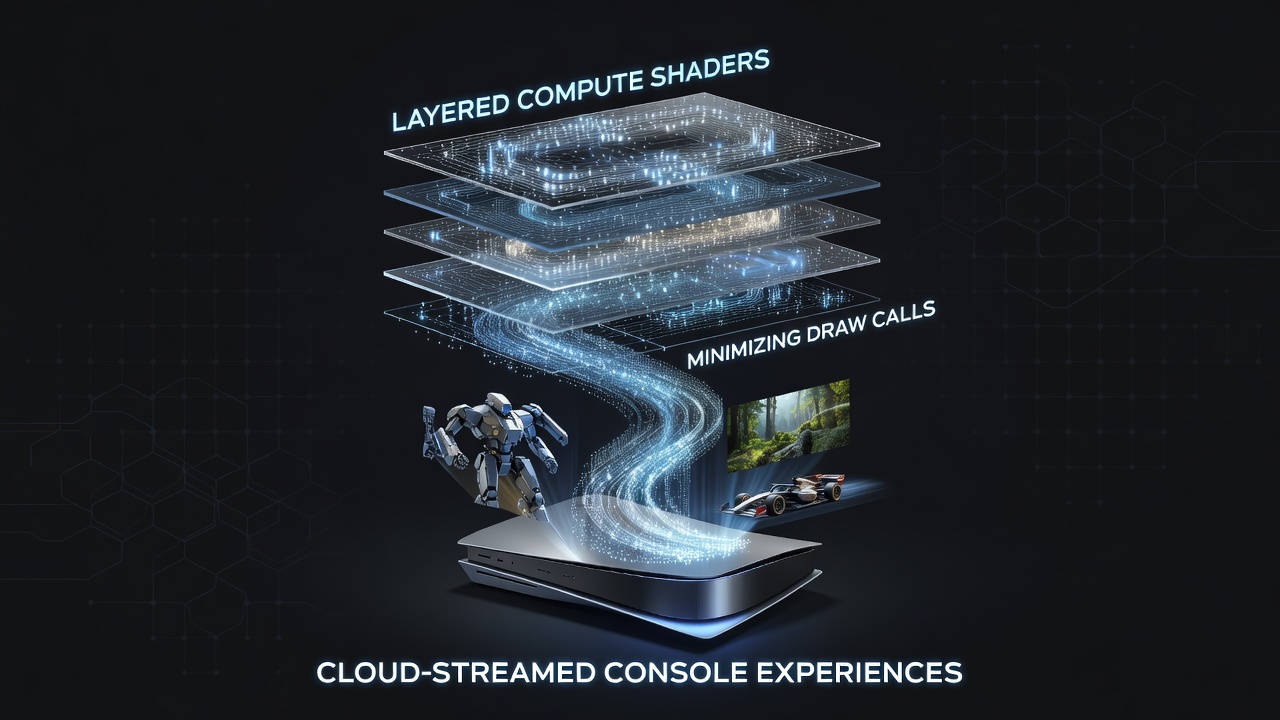
Cloud-streamed console experiences rely on efficient rendering pipelines to deliver responsive gameplay across distributed networks, and layered compute shader techniques address draw call overheads by batching operations that would otherwise trigger frequent CPU-GPU synchronization points. Researchers at various institutions have documented how these methods reorganize traditional rendering workflows into compute-based stages that consolidate geometry processing, culling, and material evaluations before any rasterization occurs.
Understanding Draw Call Overheads in Streaming Contexts
Each draw call represents a command sent from the CPU to the GPU, and in cloud environments the latency compounds when network transmission joins the equation, so developers consolidate multiple objects into single submissions through compute shader layers that pre-sort and instance data on the GPU itself. Data from industry reports indicate that unoptimized titles can generate thousands of draw calls per frame, while layered approaches cut that number by grouping similar meshes and shaders into unified buffers that the GPU processes in parallel.
Console hardware from major manufacturers already supports extensive compute capabilities through APIs like DirectX 12 and Vulkan, which allow explicit control over resource states and command lists, and these foundations enable the layering strategy where one shader pass prepares data for the next without returning control to the CPU until the final output stage.
How Layered Compute Shaders Operate
Layering begins with an initial compute dispatch that performs frustum and occlusion culling across large scene datasets, writing visible instance indices into compact buffers that subsequent layers read to apply transformations and material lookups. A second layer might then generate indirect draw arguments, eliminating the need for separate CPU-side draw calls for each object type while maintaining correct ordering through atomic counters adn prefix sums.
Further layers handle particle systems or procedural geometry by emitting vertex data directly into render targets, and this chaining keeps all work on the GPU until the rasterizer stage receives a minimal set of commands. Observers note that such pipelines scale particularly well when scenes contain high instance counts, because the compute units handle variability that would fragment traditional draw submissions.
Application to Cloud-Streamed Console Workflows
In cloud setups the server renders frames that stream to client consoles, so reducing draw call overhead directly lowers both server CPU utilization and the size of command buffers that must traverse internal data paths before encoding. Studies from academic groups in North America and Europe have measured frame time reductions when layered compute replaces scattered draw calls, particularly during peak multiplayer sessions where many players share the same world state.
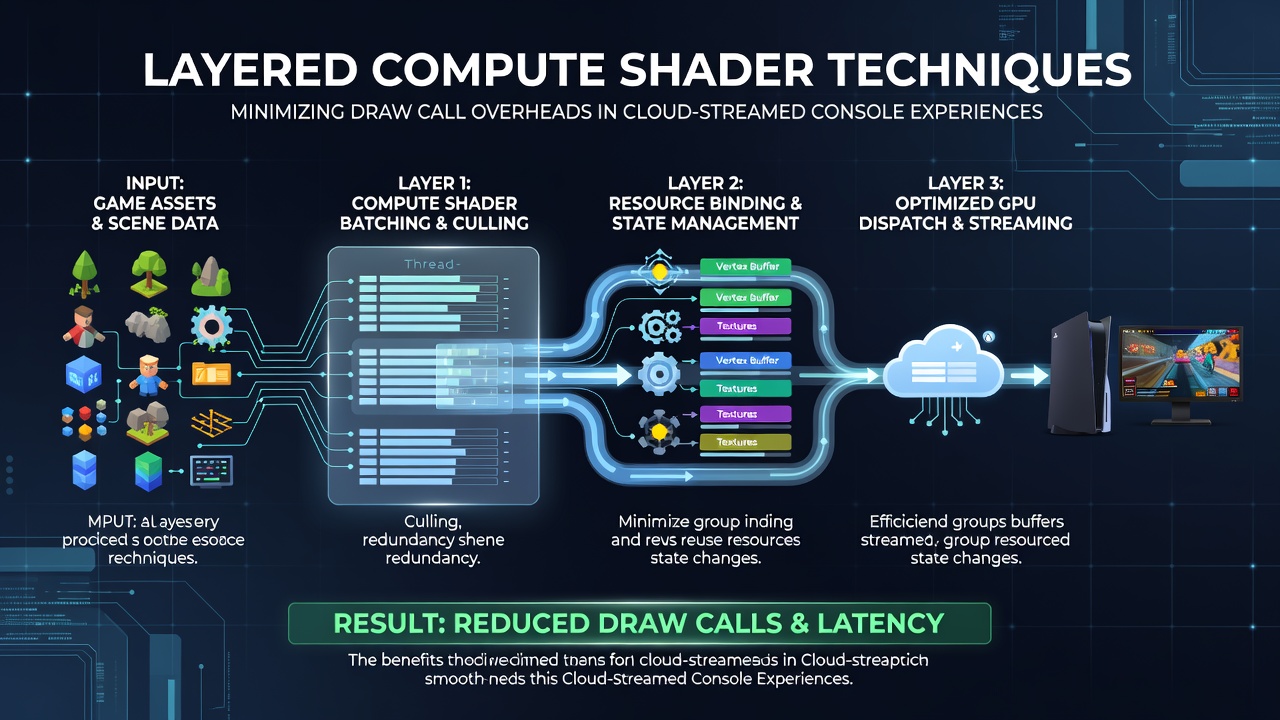
Network conditions in June 2026 showed continued emphasis on edge server placement, and titles using these techniques maintained stable frame delivery even when input lag margins tightened during tournament events. The approach integrates with existing foveated or variable rate shading passes because the compute layers already operate on screen-space data structures that adapt to resolution changes without additional draw call overhead.
Performance Metrics and Implementation Patterns
Figures from hardware vendors reveal that well-structured layered shaders can reduce draw call counts from several thousand to under one hundred per frame in dense environments, while GPU occupancy remains high because compute workloads fill execution units that would otherwise idle during traditional rendering. Developers achieve this by carefully sizing thread groups and using shared memory to pass intermediate results between layers without global memory round trips.
One documented case involved a third-person action title where indirect execution combined with compute-driven visibility produced a 40 percent drop in CPU time spent on rendering submissions, according to internal profiling shared at developer conferences. Another pattern appears in open-world streaming where level-of-detail transitions occur entirely within compute passes, avoiding the CPU cost of updating per-object constants each time a mesh swaps resolution.
Industry organizations such as the Khronos Group continue to refine API extensions that simplify multi-layer compute dispatch, and parallel efforts at institutions like the University of Waterloo explore compiler techniques that automatically detect opportunities for shader fusion across layers. These advances matter because cloud providers allocate fixed CPU cores per session, and any reclaimed cycles can support additional simulation or AI workloads instead.
Integration Challenges and Solutions
Debugging layered compute pipelines requires specialized tools because intermediate buffers lack the human-readable structure of traditional draw calls, yet console manufacturers supply enhanced GPU analyzers that trace compute-to-graphics transitions in real time. Synchronization between layers relies on UAV barriers rather than full pipeline stalls, preserving throughput while ensuring data coherence across dispatches.
Memory bandwidth considerations remain central, since each layer reads and writes buffers that must fit within high-speed caches; practitioners therefore reuse storage across unrelated passes once prior results are consumed. Cross-platform titles benefit because the same shader source compiles to different console architectures, provided developers abstract resource binding through consistent descriptor models.
Conclusion
Layered compute shader methods continue to reshape how draw call overheads are managed in cloud-streamed console titles by shifting decision-making onto the GPU and consolidating submissions into minimal command streams. Research indicates sustained adoption across studios as network infrastructure expands, and the techniques align naturally with the resource constraints of shared cloud hardware. As console generations evolve, these patterns provide a foundation for maintaining visual fidelity without proportional increases in CPU or network demands.