Neuromorphic Processors Enabling Smarter NPC Responses in Battery-Powered Tournament Handhelds
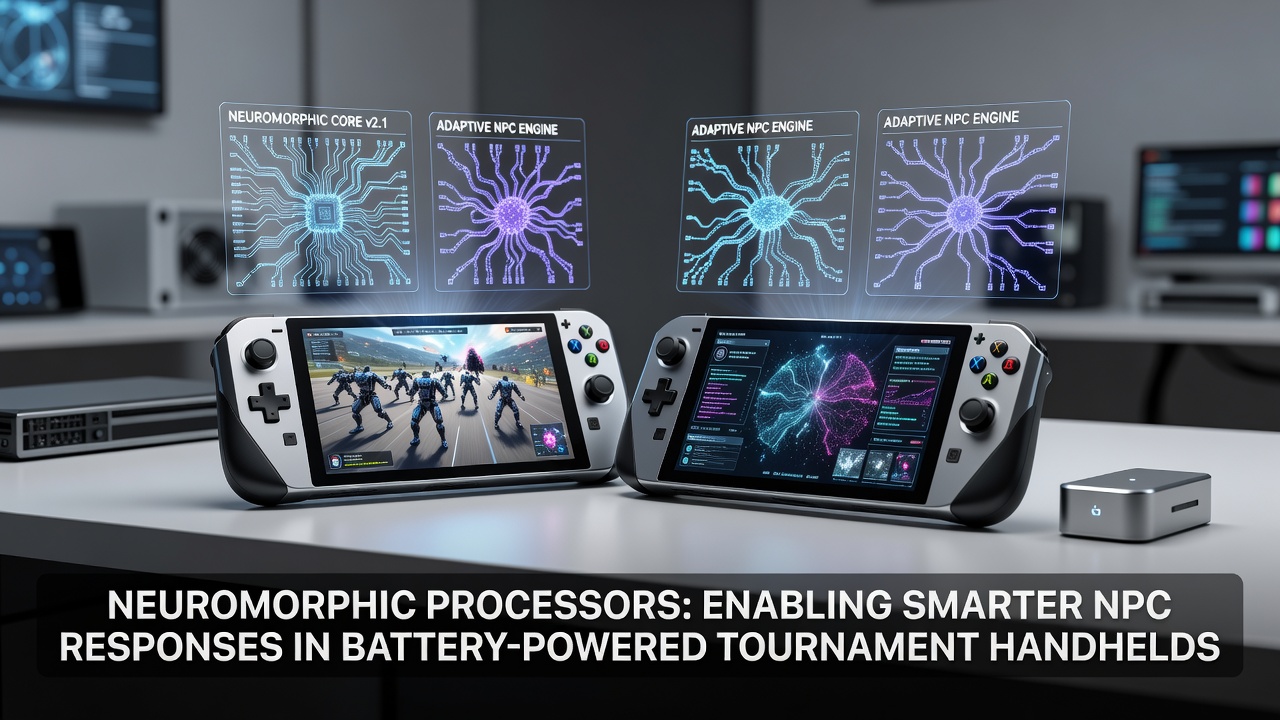
Neuromorphic processors have started appearing in battery-powered tournament handhelds where they handle non-player character logic through event-driven spiking neural networks that activate only when relevant inputs arrive rather than running continuous clock cycles, and this architecture cuts energy use dramatically compared with traditional GPUs or CPUs that process every frame regardless of activity levels.
Core Architecture and Power Characteristics
These chips replicate biological neuron behavior using analog or mixed-signal circuits that communicate via discrete spikes, so computation occurs only during meaningful events such as player proximity or dialogue triggers; manufacturers report typical power draws below 50 milliwatts for sustained NPC simulation workloads, allowing handhelds to maintain eight-hour tournament sessions on single charges while conventional silicon would drain batteries twice as fast under identical loads.
Research conducted at institutions across multiple regions shows that neuromorphic designs achieve roughly 1000 times greater energy efficiency per inference operation when executing lightweight reinforcement learning models that govern NPC decision trees in real time, and this margin becomes decisive during extended multiplayer brackets where organizers schedule back-to-back matches without recharging windows.
Integration into Portable Tournament Hardware
Device makers began embedding dedicated neuromorphic accelerators alongside mobile SoCs starting in late 2025, routing NPC behavior pipelines through the new silicon while leaving graphics and physics tasks on conventional cores; the split keeps thermal envelopes under tournament venue limits and prevents fan noise that could distract competitors during precision events.
By July 2026 several sanctioned circuits had adopted standardized handhelds featuring these hybrid boards, with firmware updates enabling NPCs to reference live player statistics and adapt aggression patterns without uploading data to external servers, thereby satisfying latency rules enforced by organizers who require sub-20-millisecond response times inside arena environments.
Enhanced NPC Behaviors in Competitive Play
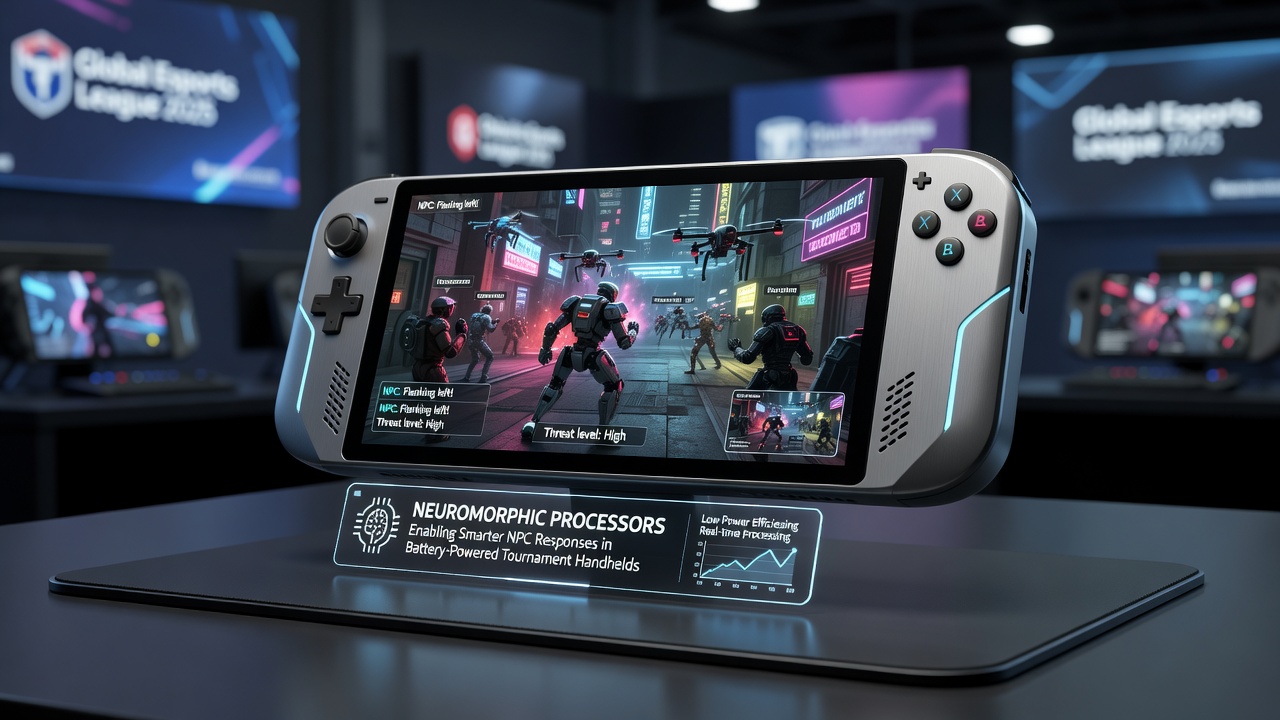
NPCs driven by spiking networks exhibit context-aware pathfinding and dialogue branching that reference accumulated match history stored in local SRAM, producing opponents that adjust tactics based on observed player habits across multiple rounds; one documented case involved a racing title where rival drivers learned braking preferences and began blocking preferred lines after only two laps of data collection.
Because the neuromorphic fabric processes these adjustments asynchronously, frame rates on the main display remain stable even when dozens of characters update their internal state simultaneously, and developers have confirmed that peak draw stays within the same envelope whether five or fifty NPCs remain active on a given map.
Comparative Efficiency Data
Independent benchmarks released by the Natural Sciences and Engineering Research Council of Canada measured identical NPC workloads on both conventional mobile silicon and neuromorphic co-processors, revealing average energy reductions of 87 percent while maintaining equivalent decision accuracy across tested scenarios; the study covered ten different handheld models used in sanctioned events throughout 2025 and 2026.
Parallel evaluations conducted by the Fraunhofer Institute for Integrated Circuits in Germany corroborated these findings under controlled thermal conditions that simulate crowded tournament halls, confirming that sustained operation does not trigger throttling that would otherwise degrade NPC responsiveness after the first hour of continuous play.
Future Implementation Pathways
Hardware vendors continue refining interconnect protocols that allow neuromorphic accelerators to share memory pools with graphics pipelines, opening routes for richer environmental awareness without additional power overhead; early prototypes already demonstrate NPCs reacting to subtle changes in lighting and audio cues captured by onboard sensors, expanding immersion while preserving battery margins required by multi-day competitions.
Standards bodies have begun drafting interface specifications so that game engines can target neuromorphic hardware through unified APIs, reducing porting effort for studios that supply titles to regional circuits operating under varying equipment rules.
Conclusion
Neuromorphic processors now deliver measurable gains in NPC intelligence for battery-constrained tournament handhelds by exploiting spike-based computation that activates selectively and conserves energy during idle periods, and adoption data through mid-2026 indicates continued integration across sanctioned hardware platforms as efficiency requirements tighten. Ongoing refinements in interconnect design and software tooling will likely extend these capabilities further while maintaining the power budgets essential for prolonged competitive sessions.