Photon Entanglement Experiments Paving Ways for Instantaneous Data Sync in Distributed Gaming Networks
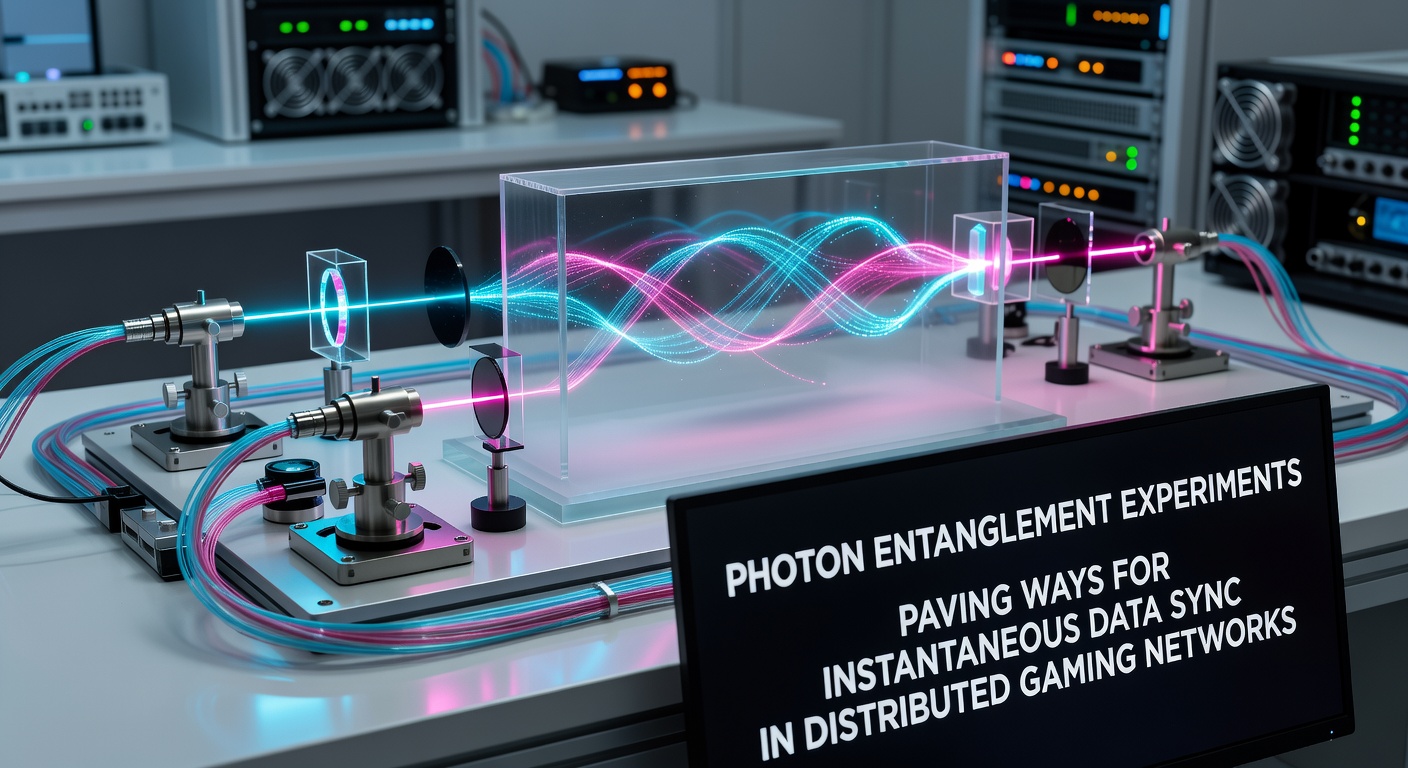 Researchers have conducted multiple photon entanglement experiments that demonstrate correlations between particles separated by significant distances, and these findings continue to inform discussions around potential synchronization methods in distributed systems including gaming networks. Experiments at facilities in the United States and Europe have generated entangled photon pairs using spontaneous parametric down-conversion, with detection rates reaching thousands per second under controlled conditions.
Fundamentals of Photon Entanglement in Network Contexts
Photon entanglement occurs when two or more photons share quantum states such that measurement of one instantly correlates with the state of the other regardless of separation distance, according to data from the National Institute of Standards and Technology. Teams measure polarization or momentum properties after photons travel through fiber optic channels or free-space links, and results consistently match predictions from quantum mechanics. These correlations have prompted investigations into whether similar mechanisms could support data consistency across geographically dispersed gaming servers.
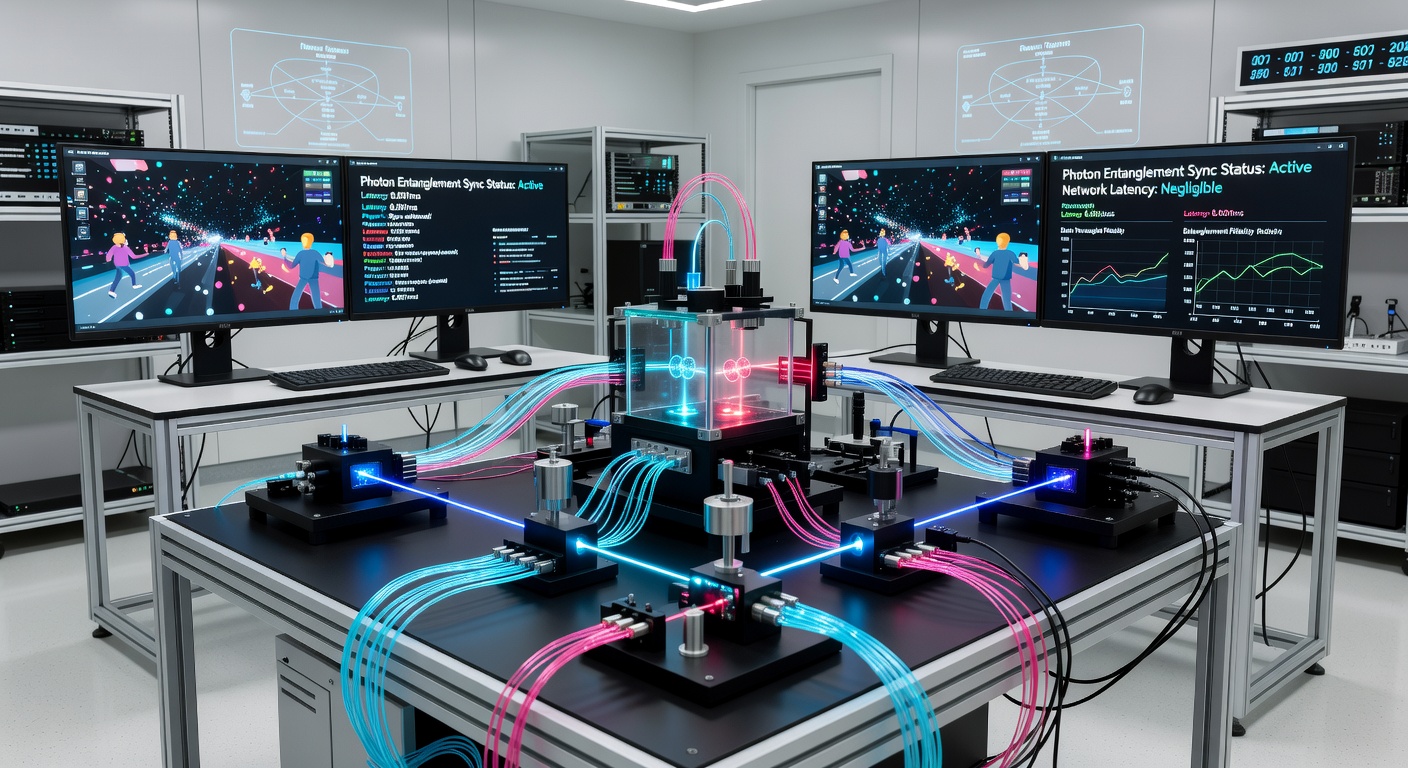
Distributed gaming networks require precise state synchronization between multiple nodes to maintain consistent player experiences during multiplayer sessions. Conventional approaches rely on classical data packets transmitted over fiber and satellite connections, which introduce latency measured in milliseconds depending on physical distance. Photon-based methods under study aim to explore whether entanglement-assisted protocols might reduce certain synchronization overheads in future architectures.
Key Experiments and Technical Developments
Experiments conducted through 2025 have extended entanglement distribution over metropolitan fiber networks exceeding 100 kilometers, with fidelity levels above 90 percent reported in peer-reviewed publications. Groups at institutions in Australia and Canada have integrated entanglement sources with existing telecommunications infrastructure, demonstrating stable links that operate alongside classical data channels. These setups use superconducting nanowire detectors cooled to cryogenic temperatures to register photon arrivals with timing precision under 10 picoseconds.
One notable trial in May 2026 involved a collaborative test between European and North American laboratories that maintained entangled states across transatlantic fiber routes for periods exceeding 48 hours. Researchers recorded coincidence counts and verified Bell inequality violations throughout the run, confirming that the quantum correlations persisted under real-world conditions including temperature fluctuations and mechanical vibrations. Such demonstrations provide concrete data points for modeling how entanglement resources might integrate into larger network fabrics.
Potential Integration with Gaming Infrastructure
Gaming platforms currently manage state replication through protocols such as rollback netcode and predictive compensation, yet these techniques still face limits imposed by the speed of light in fiber. Studies from research institutions indicate that hybrid quantum-classical networks could handle specific synchronization tasks by distributing entanglement beforehand and using it for verification steps rather than bulk data transfer. Quantum teleportation protocols, which require classical communication channels, have been tested in laboratory settings with end-to-end latencies below those of standard internet routes for small information units.
Industry reports from gaming hardware consortia note that developers are examining quantum random number generation derived from entangled sources to enhance fairness in matchmaking and anti-cheat systems. These generators produce bits with entropy levels that surpass conventional pseudo-random algorithms, and several titles have incorporated similar technology in beta builds during 2025. The approach supplies verifiable randomness without increasing bandwidth demands on existing client-server connections.
Challenges and Current Limitations
Photon loss in optical fibers remains a primary constraint, with attenuation rates requiring quantum repeaters that are still under development. Teams have demonstrated rudimentary repeater nodes using atomic ensembles, yet scaling these devices to support thousands of simultaneous gaming sessions involves engineering hurdles documented in publications from the European Quantum Flagship program. Decoherence caused by environmental interactions further reduces entanglement lifetime, necessitating frequent regeneration of photon pairs.
Standardization efforts continue through bodies such as the International Telecommunication Union, which has outlined preliminary frameworks for quantum network interfaces. These documents specify wavelength allocations and timing protocols that would allow coexistence with classical traffic in shared infrastructure. Implementation timelines depend on further advances in detector efficiency and source brightness, areas where incremental improvements appear in quarterly technical updates from multiple laboratories.
Outlook for Distributed Systems
Projections based on current experimental trajectories suggest that small-scale quantum-enhanced synchronization testbeds could appear in controlled gaming environments by the late 2020s. Data from ongoing trials indicate that entanglement distribution rates of several hundred pairs per second already suffice for auxiliary tasks such as cryptographic key refresh, while higher rates would be needed for direct state transfer applications. Continued investment from government agencies across North America and Asia supports parallel development paths that include both fiber and satellite-based entanglement links.
Conclusion
Photon entanglement experiments supply measurable correlations and distribution metrics that researchers are evaluating for possible roles in future data synchronization architectures. Developments through May 2026 have extended link stability and integration capabilities, yet practical deployment in distributed gaming networks depends on solutions to loss, decoherence, and scaling challenges. Continued data collection from international collaborations will determine which specific synchronization functions, if any, transition from laboratory demonstrations to operational gaming infrastructure.