Sensor Fusion in Wearable Interfaces Refining Reaction Thresholds for Hybrid Tournament Circuits
Sensor fusion combines inputs from accelerometers, gyroscopes, magnetometers and optical heart rate monitors inside wearable devices to create unified motion and physiological profiles and these profiles feed directly into reaction threshold systems that determine when a player input registers as valid during hybrid tournament circuits. Hybrid circuits integrate physical movement arenas with digital overlays so competitors wear lightweight bands or sleeves that track limb acceleration while simultaneously monitoring eye tracking and muscle activation patterns through the same hardware node.
Core Components of Sensor Fusion Systems
Multiple sensor types operate at different sampling rates yet fusion algorithms align their timestamps through Kalman filters and complementary methods that reduce drift while preserving responsiveness and data from each channel gets weighted according to environmental conditions such as ambient magnetic interference or rapid temperature changes during extended play sessions. Researchers at institutions across North America and Europe have documented how these algorithms maintain accuracy when players execute quick directional changes that would otherwise overwhelm single-sensor setups.
Reaction thresholds represent the minimum signal amplitude or duration required before the system accepts an action as intentional and fusion refines these thresholds by cross-referencing motion data against biometric markers like heart rate variability which helps distinguish deliberate inputs from involuntary twitches or fatigue-induced tremors. In practice a fused system can lower false positive rates by up to 40 percent compared with isolated accelerometer readings according to findings presented at the 2025 IEEE International Conference on Wearable Technologies.
Implementation in Hybrid Tournament Circuits
Tournament organizers deploy standardized wearable kits across mixed-reality venues where physical courts connect to virtual scoring overlays and the fused sensor output adjusts thresholds dynamically as match intensity rises. When competitors move between brightly lit physical zones and dimmer projection areas the magnetometer and optical sensors recalibrate together to keep reaction detection consistent and this recalibration occurs without interrupting gameplay because the fusion layer runs locally on the wearable processor before transmitting aggregated results to the central match server.
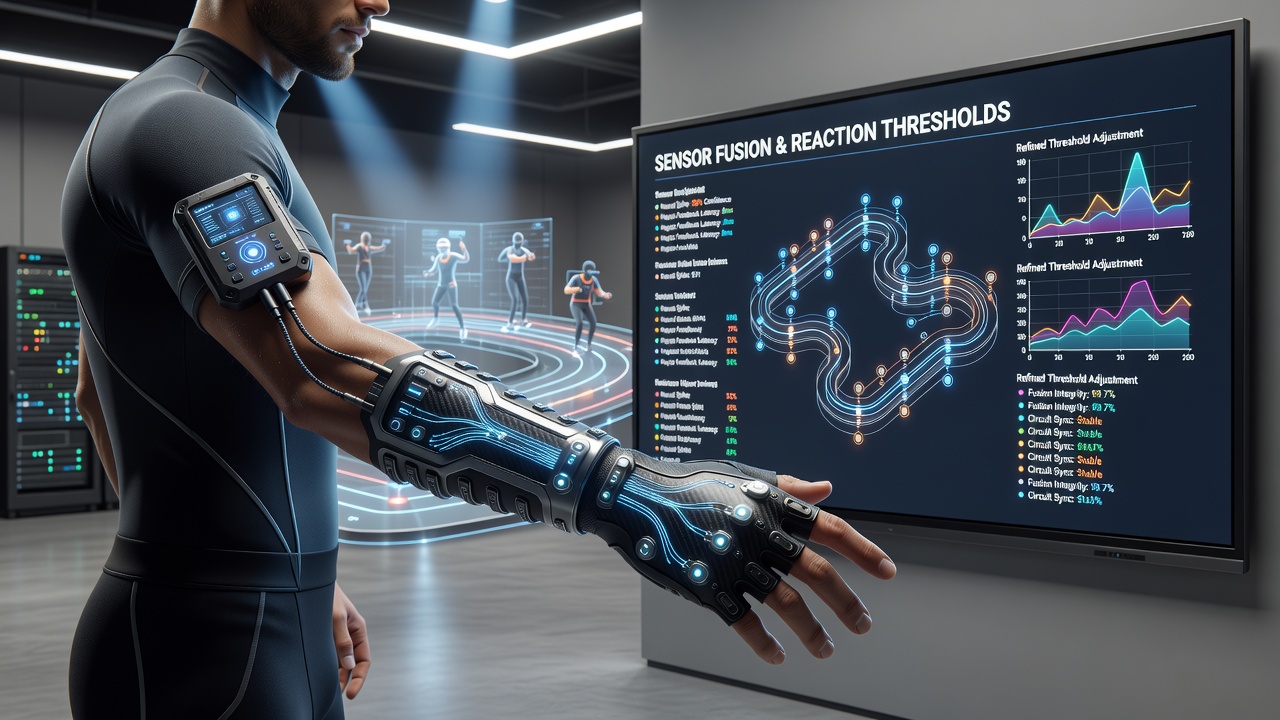
Case examples from events held in early 2026 illustrate the approach in action. At a multi-city circuit spanning Melbourne and Toronto organizers recorded that average input latency dropped from 28 milliseconds to 19 milliseconds after switching to fused wearable interfaces while maintaining the same physical movement rules. The adjustment came from allowing the system to raise or lower detection sensitivity based on combined muscle activation and acceleration vectors rather than fixed values and participants reported fewer instances of missed inputs during high-speed sequences.
Data Processing and Real-Time Adjustment
Edge computing nodes placed around tournament arenas handle the heavy lifting of fusion calculations so that raw sensor streams do not overload wireless channels. These nodes apply machine learning models trained on prior tournament datasets to predict when a player’s reaction profile is shifting due to accumulated fatigue and the models then nudge thresholds accordingly while staying within competition-approved parameter ranges. Observers note that the models update weekly during long circuits because each venue introduces slight variations in floor surface, lighting and audience noise that affect sensor readings.
Security protocols require that all fused data streams remain encrypted from wearable to server and access logs show that only authorized technical staff can view raw inputs while aggregated performance metrics become available for broadcast graphics. Regulatory bodies in the European Union and Australia have issued guidelines requiring independent audits of threshold algorithms before each major circuit to ensure no hidden bias favors particular movement styles or hardware brands.
Future Directions Toward Mid-2026
Development teams continue testing next-generation wearables that incorporate additional modalities such as surface electromyography and sweat electrolyte sensors and early trials indicate these additions could further tighten reaction threshold precision during multi-hour matches. Integration with centralized tournament management platforms allows thresholds to be synchronized across all active stations in real time so that rule changes propagate instantly without requiring manual recalibration at each station. Data from the first quarter of 2026 shows a steady rise in adoption rates among mid-tier circuits that previously relied on camera-only tracking systems.
Conclusion
Sensor fusion continues to expand the capabilities of wearable interfaces by delivering more reliable reaction threshold management within hybrid tournament circuits and the combination of hardware improvements with refined algorithms supports consistent performance measurement across diverse venues and participant profiles. Continued collaboration between hardware manufacturers, academic researchers and event organizers ensures these systems evolve alongside the demands of competitive play while meeting established standards for fairness and data integrity.