Waveguide Optics Advancements Enabling Clearer Overlays in AR Esports Training Modules

Waveguide optics have progressed through refinements in diffractive and holographic structures that direct light more efficiently within compact AR headsets used for esports training, and these changes produce overlays with reduced distortion and improved brightness uniformity across the field of view. Research teams at institutions in North America and Europe have documented gains in light throughput that reach 70 percent or higher in prototype systems tested during 2025, allowing virtual elements such as aim trajectories and opponent heat maps to appear sharper against real-world backgrounds during practice sessions.
Engineers achieve these results by patterning nanoscale gratings onto thin glass or polymer substrates, which then couple incoming light from micro-displays into guided modes that propagate along the waveguide before out-coupling toward the user's eye. Earlier designs suffered from color fringing and limited exit-pupil expansion, yet recent iterations incorporate multi-layer volume holographic elements that separate red, green, and blue channels more precisely and thereby cut chromatic aberrations that once blurred fast-moving training cues.
Technical Mechanisms Behind Improved Clarity
Data from laboratory characterizations show that surface-relief grating waveguides now support angular bandwidths exceeding 50 degrees while maintaining modulation transfer function values above 0.6 at 20 cycles per degree, figures that translate directly into legible text and icon overlays at typical esports viewing distances. Manufacturers have introduced hybrid refractive-diffractive combiners that balance the trade-off between field of view and eyebox size, and these components appear in training rigs deployed by several professional teams ahead of the 2026 competitive calendar.
One notable development involves the integration of tunable liquid-crystal layers atop the waveguide stack, permitting dynamic adjustment of focal planes so that overlaid graphics remain crisp whether the trainee focuses on a physical controller or a distant monitor. Measurements reported in peer-reviewed optics journals confirm that such varifocal waveguide modules reduce vergence-accommodation conflict during extended sessions that last two hours or more.
Integration With Esports Training Platforms
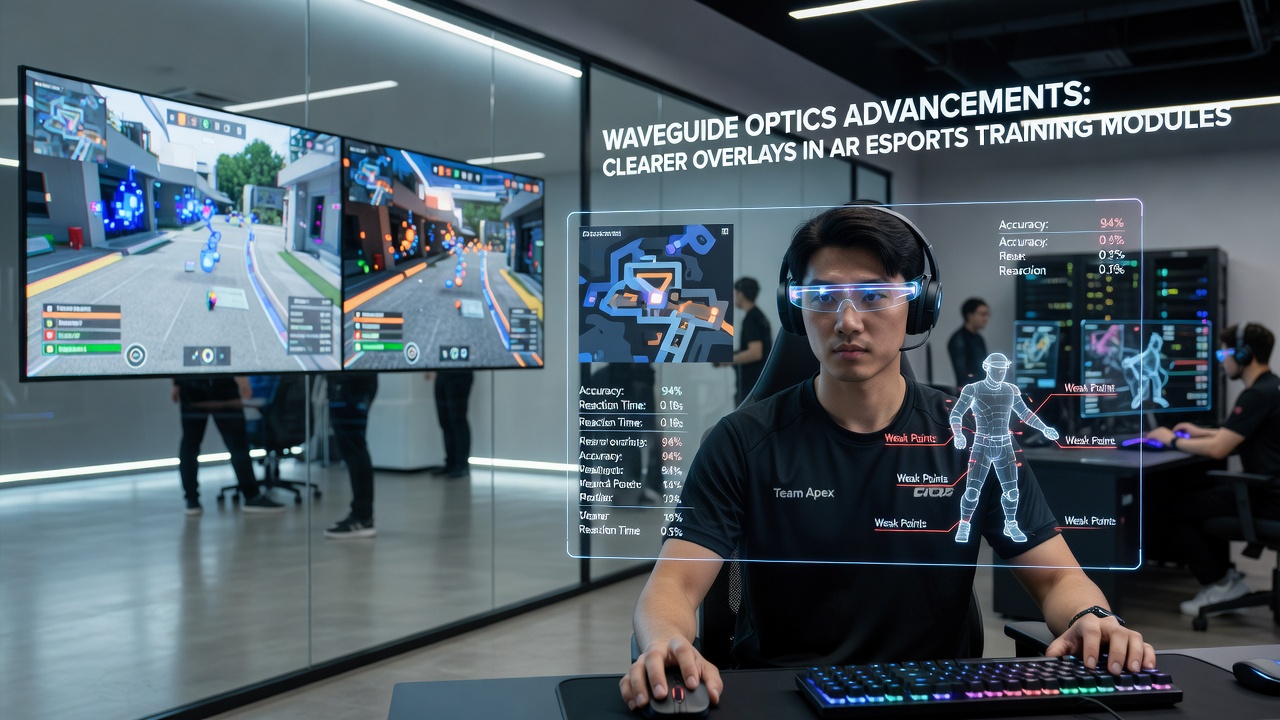
Training modules built around these waveguides overlay real-time performance metrics onto live camera feeds from practice arenas, and the increased clarity allows coaches to highlight subtle posture adjustments without the visual noise that previously obscured fine details. In July 2026 several North American leagues began pilot programs that stream AR-enhanced drills to remote analysts, relying on the waveguides' improved light efficiency to keep headset power draw under 8 watts during continuous operation.
Case studies from European development labs describe how waveguide-based systems render particle effects and trajectory lines with sub-pixel alignment to physical targets, enabling trainees to practice flick shots and tracking exercises under conditions that closely replicate tournament lighting. The same optics also support eye-tracking integration, since the expanded eyebox accommodates the infrared illumination sources without introducing additional scatter.
Material and Manufacturing Progress
Advances in nano-imprint lithography have lowered production costs for high-precision gratings, allowing smaller studios to incorporate waveguide optics into custom training headsets rather than relying solely on commercial off-the-shelf units. Australian research groups have explored chalcogenide glass compositions that exhibit lower propagation losses in the visible spectrum, extending battery life during mobile tournament preparation sessions that require untethered operation.
Industry reports from semiconductor foundries indicate that wafer-scale replication techniques now yield waveguides with surface roughness below 2 nanometers rms, a threshold that minimizes stray light and ghost images that once competed with critical training information. These manufacturing improvements coincide with software pipelines that pre-distort rendered overlays to compensate for residual waveguide aberrations, resulting in final perceived sharpness that meets or exceeds legacy LCD-based training displays.
Performance Metrics in Competitive Contexts
Controlled trials conducted at university esports labs measured reaction times and decision accuracy when participants used waveguide-enhanced AR versus conventional monitor setups, and the results showed consistent reductions in visual search latency for overlaid threat indicators. The waveguides' high transparency also preserves situational awareness of physical surroundings, an attribute valued during mixed-reality drills that blend live opponents with virtual obstacles.
Networked training environments further benefit because clearer overlays reduce the cognitive load associated with interpreting ambiguous graphics, allowing athletes to maintain focus across multiple simultaneous data streams such as health bars, cooldown timers, and positional heat maps. Hardware specifications released in early 2026 list waveguide combiners supporting 90 frames per second at 4K per eye with total system latency below 20 milliseconds when paired with current generation tracking cameras.
Conclusion
Waveguide optics continue to evolve through iterative improvements in grating design, material selection, and system integration that directly enhance overlay legibility in AR esports training modules. The documented gains in brightness, field uniformity, and aberration control position these components as foundational elements for next-generation preparation tools, while ongoing fabrication refinements support broader deployment across regional and international competitive circuits.